GRAPE CHALCEDONY
ABOUT THE SPECIMEN
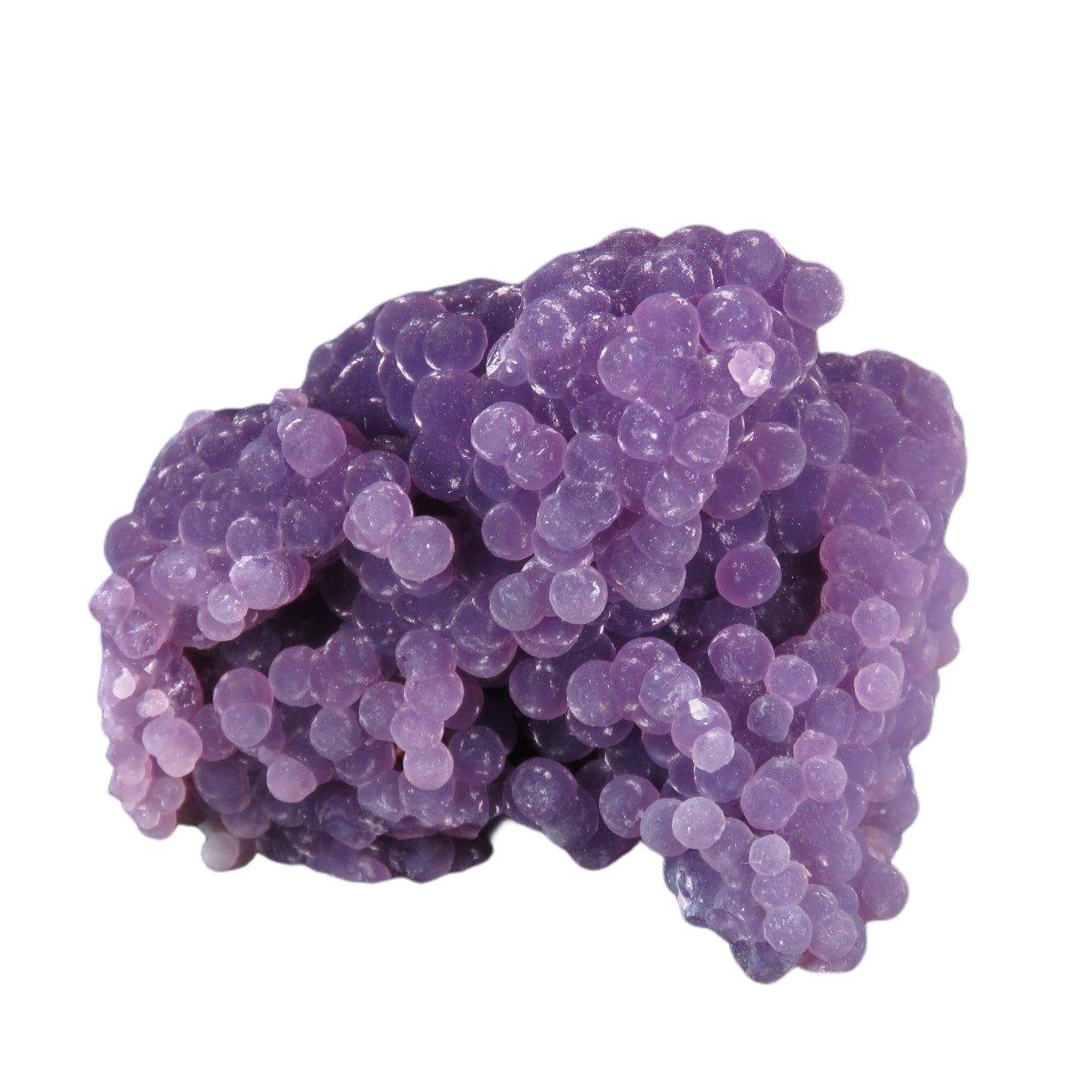
Deep purple grape chalcedony in a small cluster. Lab analysis revealed that these specimens consist of botryoidal amethyst rather than chalcedony, but the title has stuck around as trade names tend to do. The color is quite striking, and the luster glimmering. Fine miniature of a unique and distinctive style.
VIDEO
MORE INFO
The Manakarra deposit sits within Indonesia's Sunda volcanic arc, where Miocene andesite extruded into cold seawater formed pillow lavas with intercalary voids - the same rapid chilling that created the pillows left cavities subsequently filled by low-temperature silica from percolating groundwater. The material is correctly identified as botryoidal amethyst rather than chalcedony, as examination under magnification reveals euhedral quartz crystal terminations on the sphere surfaces; the trade name "grape chalcedony" has nonetheless stuck since the material's debut at Denver in 2016 and Tucson in 2017, and is now effectively universal in the market. Purple color is attributed to trace iron in the quartz structure combined with natural irradiation, the same mechanism responsible for conventional amethyst, with manganese potentially contributing in the most intensely colored specimens. Spheroids grow in compact bundles within pillow lava voids, occasionally filling cavities entirely to produce dense clusters that retain the curved outer surface. A rarer green variety occurs alongside the purple, with color attributed to included clay minerals - illite or smectite - derived from mafic host rock alteration. Extraction is entirely by hand through pits sinking several meters into hard andesite, keeping throughput limited; fine specimens with saturated deep purple color, complete spheroids, and intact three-dimensional clusters are a small fraction of total recovery.